ANIMAL VOICES (2)
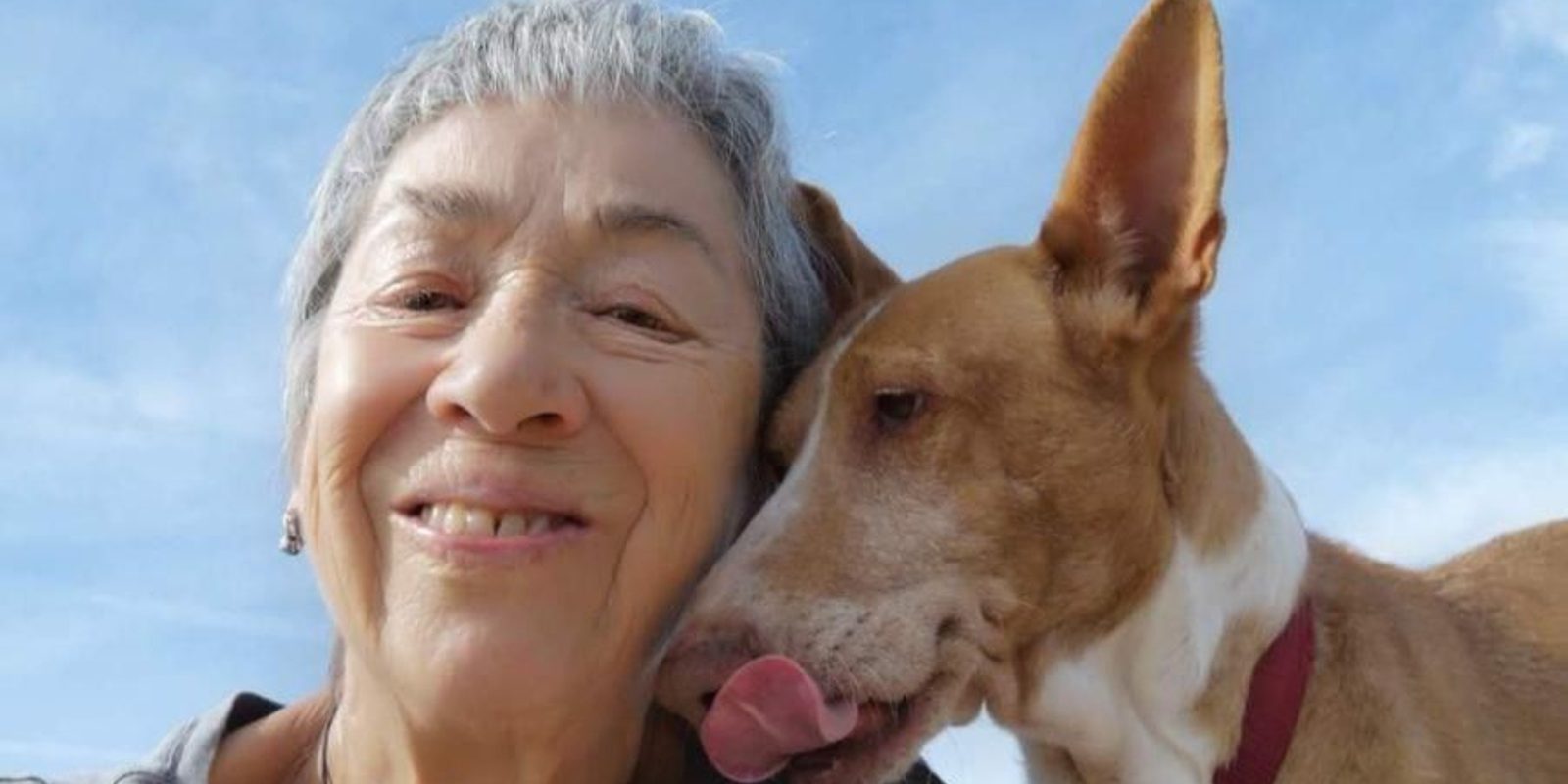
Surya and Nisha, my beloved dogs:
“Love produced the voice!”
Anabela Cardoso
Key words:
EVP (electronic voice phenomena), DRV (direct radio voices), electronic voices, ITC (Instrumental Transcommunication), ORIG (original recording), NR (edited with slight noise reduction).
______________________________________________________________________
My dog Surya is the beacon that drove me to Rio do Tempo. Even today, 33 years after his departure from this world, I still feel the pain and think about the profound transformative impact it had on me and my life. He changed everything, including my way of living and thinking. Without him I would have been a totally different person.
Undoubtedly, this is the true power of love in its full meaning.
He also started the thread of love that made me rescue and shelter many dozens of dogs and cats in need that crossed my life after him. He is the light that keeps me alive, in the conviction that we will all meet again in a new world, “a pure world”, as my communicators call the new dimension of life where they live.1 Listen to a fragment of a much longer audioi in which the communicators speak of their “pure world”.
Note: Before my readers listen to the voice samples posted here, I want to make a recommendation.
They should listen a couple of times to the noisier audios. In the majority of cases, the electronic voices do not resemble the voices of the deceased people they purportedly belong to. This is only natural because they are synthetically produced, not physically produced. There are exceptions but those are more likely to happen in EVP voices, not in the DRV. I don’t know the reason for this, and as far as I know, nobody knows.
iiAUDIO 1. 2004 08 18_11 19 side A_É doutro mundo puro (It’s from another pure world) ORIG + NR
AUDIO 1.2 Anabela about mundo puro
He came into my life in New Delhi, India, where I was stationed as a diplomat. I adopted him from a friend’s house, a lady of noble ancestry named Geeta whose surname I cannot remember. He was the shyest and the quietest of her several
Doberman puppies and the one who stayed by me all the time I was at her house.
I brought him home and at the beginning of his life, he was mostly cared for by my domestic staff, mainly my faithful Ram Prasad Godyal who accompanied me for many years and whom I still love as much as I love my own brother to whom I am very attached.
Ram Prasad died years ago when I was stationed in Lyon, France but we never lost contact even after his death as I have received a couple of voices apparently from him.
Geeta had called him Sultan Suleiman but I officially changed his name to Surya, the sun god of Hinduism. For some unknown reason, I had fallen in love with God Surya, so I immediately chose Surya as his name.
This EVP voice is a typical example of the classical EVPs – the anomalous voice is preceded by two loud knocks. I left the actual times and all the noises unchanged so my readers can check it.
In this beautiful, very moving recording, the anomalous voice responds to my lament for his death and to my request to Carlos de Almeida to convey a message of love to my dog, with “Luz de Ra!” (Light of Ra!). We know that Ra is the Egyptian Sun god, the god of Light and Power, the creator of all things.
AUDIO 2. “LUZ DE RA!” (original audio)iii.
Ra is the creator and my dog Surya awakened in me the love for ITC and increased my devotion to all animals, especially dogs, to unimaginable levels. As Adolf Homes’ communicators say: “The signs of metamorphosis include many symbols that come from other dimensions” (Senkowski, 1999, p. 83).
It is difficult to distinguish between myth and reality, and I think that in many instances they are one and the same… I also think that this is a good example of the important role symbol and metaphor play in ITC messages.
Soon my Surya, who never left my side, became the love of my life. He followed me everywhere, moving when I moved, always, without fail. He would look at me with his beautiful, sad black eyes for hours as if adoring me. It was very moving and, little by little, I was caught in the magic of his being.
My mother used to call him ‘the philosopher’ for his serious and thoughtful posture. He was also a sick puppy who frequently had a kind of epileptic seizures that no one could properly diagnose. Years later, a veterinarian decided that he must have suffered an undetected brain injury because suddenly, without previous warning or reason, he would start shaking his head from side to side, in great affliction, for a considerable lapse of time. Some five or more minutes would go by and then it all stopped.
These strange, unexplained occurrences worried me terribly because I didn’t know what to do to help him. The veterinarians were not conclusive about what triggered the seizures; therefore, I lived with the fear of the next one, which could come at any moment without warning. Some were very frightening and, on those occasions, I thought it would not stop and he would die. My dog did not lose consciousness but he seemed very anxious about the situation, which he couldn’t control. And I would feel like dying with him every time it happened.
I must confess that just remembering the terrible illness my Surya suffered still disturbs me and causes great anxiety; therefore, I prefer not to continue with the description. The memory of his convulsions has left a painful mark on my spirit.
From his new world, Surya spoke directly with me few times only, at least with proper identification. When I asked my communicators why this happened, they replied, “you get very disturbed and thus, you cannot communicate with him…” It was true because even today, thirty-three years after his death, thinking about the terrible suffering my dog endured before leaving this world still disturbs me deeply. I don’t like to continue because it makes me very sad, but I will add that I stayed by his deathbed day and night, for four full days and nights, without moving for anything, occasionally drinking a glass of milk and eating a bread sandwich right there.
In the middle of the fourth sleepless night, I told my then housekeeper, Mukesh Godyal, Ram Prasad’s son, that I would lie down on the couch in the bedroom opposite the living room where we were for a few minutes because I was totally exhausted and desperate. And in those twenty minutes or so that I left him, my beloved Surya left our world. Of course, I cannot be sure but I think that he was able to finally leave his body at that moment, exactly because I was not by his side. Howe ver, today I am sorry for having involuntarily prolonged his agony. I only wanted him to know that I was by him and with him to the end. This was the most horrific situation I experienced during my whole life.
My communicators from Rio do Tempo station have spoken about my dog several times. With great insight, when they talk about Surya, they refer to him as “your dog” (usually they say “teu perroiv”, less frequently “teu cão”) in a personalized way. When they speak about the many other dogs I loved and cared for, they say, “there’s a dog coming”, or “a dog is here”, or (his/her name) is here, etc.
An incredible psychophonic event!
Next, you will find pieces of one of the most fascinating audios I received from Rio do Tempo Station. Not so much because of mentioning my dog’s name and the puppies, but because at a certain point, the male voice utters unintelligible sounds that I could not understand even after innumerable attempts.
But I kept trying until one day, for no particular reason, I reversed the audio clip and suddenly, everything became clear. It said: o Luis, Bela! as you can check for yourselves. A few seconds later, the male voice repeated the same sounds with the same effect in the reverse mode. In the original long recording, the word “Flabio” appears 4 times, some clearer than others. I copied one of those separately for better analysis of this so important paranormal event (the original audio is followed by the noise reduction version). Luis is my deceased brother’s name and Bela is my pet name.
Like all my other DRV recordings, this is a very long recording of approximately 25
minutes. I’ve divided most of these recordings into segments to make them easier to listen to. Each audio clip contains only the most interesting and informative content, relevant to what I’m describing.
AUDIO 3.1 2009 08 02 Flabio_Reverse: O Luis Bela_Este é o Cardoso ORIGINAL CD
AUDIO 3.2 Este é o Cardoso with Anabela NR
I published excerpts from this recording on my CD that contains samples of Rio do Tempo’s voices (https://www.itcjournal.org/?p=4621), and I publish this important example here, also.
This is a remarkable recording for many reasons. To begin with, it gives me information about some of the beings I love most – my dog, my father, my brother, my mother, my puppies. But it does not mention Nisha, perhaps because Nisha had already spoken many times before…
The male voice, which identifies itself as being that of my father (or my brother), “Este é o Cardoso!”, uses an extremely interesting expression to say that it can speak, “I have playback!” What exactly does it mean? That’s an open question…
For easier understanding for those who do not speak Portuguese, the last section of the audio I called “Este é o Cardoso” can be listened to separately (original followed by slight Noise Reduction) as can the clip Flábio – O Luis Bela (in reverse).
AUDIO 3.3 last of FLABIO_O LUIS BELA_Surya puppies_Este é o Cardoso ORIG+NR
AUDIO 3.4 Only FLABIO_O LUIS BELA_ORIG+NR
The acoustic situation in which a recording is reversed and produces content completely different from what it should be, is something very rare in the history of anomalous electronic voices and cannot occur in normal acoustics.
As far as I know, this has only been documented during Friedrich Jürgenson’s experiments, although there may be other cases of which I am unaware. Jürgenson’s acoustic anomaly was thoroughly analysed and discussed at the highest level by the sound technicians of the SBC (Swedish Radio and Television) and at the Max-Planck
Institute (see Cardoso 2023, pp. 105-108). Jürgenson’s recording of the deceased Felix Kersten’s voice in reverse, was classified as “technically impossible”. My own “Flábio” which becomes “O Luis Bela” falls into the same category.
Other extracts of audios that mention my dog
The next audio is very interesting and meaningful not only because it mentions my dog but also because it gives us a hint into the nature of the next world.
The main voice says: “Your dog has voice” (translation); this implies that only some have a voice, that is, they can speak to our world, as communicators have reported on other occasions. However, I don’t rule out that the term “voice” also has a symbolic meaning or other implications. And it continues: “Nesta terra estamos bem” (In this land we are fine), a wonderful confirmation of the excellence of the other world that we have seen described by others, for example, mediums, other high-level ITC messages, such as those received in Luxembourg, the anomalous computer texts received by Adolf Homes and perhaps other sources.
Since I’m telling my readers about him, I decided to present the clip about my dog (a fraction of the original 15-minute recording) separately. And I copied and explained the content of the audio clip in a second audio.
AUDIO 4.1 ORIG+NR 2011/05/15 Teu perro tem voz_nesta terra estamos bem_o amor produz, produziu a voz.
AUDIO 4.2 Anabela explains (from the NR clip)
I think that the communicators’ extraordinary statement “love produces, produced the voice” is of utmost importance because it reveals the intrinsic nature of the next world – a world of very different values from those that prevail in our world. A world in which love can create matter, in this case “the voice”.
I also find the extraordinary grammatical precision of the voice very interesting; it says “o amor produz” (love produces) and then corrects it to “produziu” (produced), in the past tense. This is very unusual, since electronic voices are often characterized by grammatical errors, which they do in fact make.
On other occasions, Rio do Tempo told me: “Bela, we speak out of love”, “this is the voice of love” and used similar expressions.
The confirmation by one of Father François Brune’s most reliable automatic writing communicators, Roland de Jouvenel, is worth noting. This remarkable young man
(https://marilynkaydennis.wordpress.com/2011/11/03/roland–de–jouvenel/) averred: “our communications are acts of supreme love…”. I was delighted when I found this and similar statements in Father Brune’s books because correspondences are very important in our field of research. They convey a shared truth (Brune, 2009, p. 31).
In the next audio, a DRV voice from Rio do Tempo station says clearly: “Perguntas teu perro” (you ask about your dog) – my voice can be heard but I hadn’t asked my question yet – and it continued: “Está cá o teu perro, ele tem voz” (your dog is here, he has voice).v
This is a perfect example of the bond of love we share with our communicators, the understanding they show for our concerns, and the kindness they offer us. Again, the fact that my dog “has voice” is highlighted, and it makes me extremely happy to know that he is joyful and in peace because the voice says “in this land we are well”!
(Examples 4.1 and 4.2).
One thing is for sure – the next world is very different from ours: “There is another world, there is another way!” as my communicators told me years ago. The powerful, the rich, the physically beautiful seem to play no particular role in that world, but the pure of heart do. Their world is “a pure world” as they call it.
AUDIO 5. Está cá o teu perro, ele tem voz
Indeed, it seems that in the afterlife only some can communicate i.e., they “have voice” as also mentioned by Father François Brune: “As I have already told you, those who can communicate are the privileged ones” (2012, p. 70). Could this be the reason why some of our deceased loved ones never communicate, while others do? I suppose this may be true, but we don’t know any more. In my own communications, Rio do Tempo has often mentioned that “… (name) has voice”.
Next, when the voices started, I greeted them, Grupo português, boa noite amigos!
(Portuguese group, good evening my friends) and the voice replied: “É a mãe com o Surya, todos sabem” (It’s the mother [my mother, I presume] with Surya, everyone knows):
AUDIO 6. 2011 06 09 É a mãe com o Surya, todos sabem
The original is followed by the NR version.
Next is one of the few recordings in which Rio do Tempo communicators call my dog “cão” in Portuguese and also “perro” in Spanish.
AUDIO 7. 2012 06 10 Teu cão está no sol com o Só_perro_teu pai
The content of this audio is mind-boggling. They tell me that my dog is in the ‘Sun’ with Só, the poor dog I rescued on a road under the blazing sun in a terrible health condition. After his death, Só became one of my main DRV communicators. The voice continues, “está no espaço”vi (he is in space), “perro!”; the audio clip ends with a very emphatic “your father!”
According to Frederic Myers’ description of the next levels of life, “the Sun” corresponds to a higher level of existence; therefore, it is a metaphor (see Cummins, 1932, 2012). It is also very touching and gratifying that the expression is being used here to refer to my dog Surya and to my dog Só in their new life.
I am baffled when I read descriptions of the next level of life made by some “survival experts” because, in general, they use the term ‘higher levels of consciousness’ only for humans, something that many spiritual teachers say is not true. I speak from the point of view of the information received from ITC communicators and they tell us otherwise…
In Luxembourg, one of the main entities that spoke with Maggy Harsch-Fischbach and Professor Senkowski, Dr Swejen Salter, affirmed “…in case people on your Earth think that we worry too much about the animals, it would be good if they understand that in our sphere, one life has the same value as another one” (Cardoso, 2010, p. 105; Schäfer, 1993, p. 202). And to me, Rio do Tempo said, “Aqui no Rio do Tempo somos todos iguais” (Here in Rio do Tempo we are all equal) (Cardoso, 2010, p. 105).
Communicators from Group Centrale told Hans Otto König in 1988: “If you believe that man is the crown of creation, this is wrong. A plant or an animal can achieve a higher [spiritual] development” (Senkowski, König, personal correspondence, 2008, Cardoso, 2010, p. 93). My reflexion about this unusual statement is: why shouldn’t it be so? Except, of course, for human arrogance and an anthropocentric worldview based on material achievements. But the Universe is not a human creation and its rules are not human based. They belong to the Divine, which cannot be scrutinized or understood (certainly not by humans…).
Going back to our audio, I had asked my communicators about the meaning of ‘living in the sun’ when, years ago, they told me: “Carlos de Almeida is in the sun!” after he stopped communicating. I had asked them what had happened to him. And about the “sun”, they answered, “Não é o teu sol, mas é um Sol” (It’s not your sun but it’s a sun); see Cardoso, 2010, pp. 98, 99.
Since Carlos de Almeida’s transition to the “sun”, my father, João Cardoso and my dog Só became the main communicators in my ITC sessions.
Furthermore, one magical afternoon at my home in Galicia, Spain, a communicator who identified himself as Filipe, suddenly said while speaking with me via DRV:
….. e sinto um Collie bem inglês e não se importune, és tão jovem como um “perro” destes…. (Portuguese but “perro” is Spanish) vii. (Translation: and I feel a very English collie and don’t bother yourself he is as young as one of these dogs).
AUDIO 8. E sinto um collie bem inglês (The original audio clip is followed by the same piece edited with noise reduction)
A very interesting thing happened when I was revising this audio in October 2025. This is a good example of the difficulties involved in the study of ITC voices. When, many years ago, I recorded Filipe’s very long conversation, I transcribed the less audible words in the middle of this clip as “… e não se pocu” after listening to it many times and not reaching a definitive conclusion. This is something that is not correct Portuguese at all, but I couldn’t understand the words properly and it sounds somewhat similar. However, as I was unsure of the content, I omitted the entire sentence from public ITC demonstrations for the fear of mistranslating it, even though it is so important to me.
But today, when I was searching for this audio to illustrate Rio do Tempo’s comments about my dog Surya, I listened to it for the umpteenth time and the whole sentence seemed very obvious to me: “…. e não se importune, és tão jovem como um ‘perro’ destes”, although I didn’t know what “não se importune” meant. In fact, I had never before heard the verb “importunar” used in such linguistic context. I knew and used this verb in the sense of, for example, “to bother someone,” but not in the sense of “I bother myself” as Filipe used it. I found this possible use in the dictionary. A remarkable linguistic situation of which I, the ITC operator, was unaware before listening to Filipe today, several years after it happened.
Although he did not mention my dog’s name, I firmly believe that Filipe addressed my ongoing concern and sadness over the passing of Surya because he affirmed (literal translation): “… and don’t bother yourself, he’s as young as one of these dogs”. I think “he” was meant for my dog because he is always in my mind, and that’s why Filipe didn’t need to specify any further. In other words, he knew what I was thinking. I’ve had proof that my communicators can read my mind, for example, when they answer even before I ask a question. They’ve confirmed this, many times. “The very English Collie” could only have been Red, an English Collie that was playing in the garden with the other six or seven dogs that lived with me at the time. I will talk about all of them in future writings.
Filipe, to whom I became very attached because he brought me wonderful news of my dog, used the word ‘feel’ instead of see or perceive throughout his long DRV talk. During the same intervention that I called ‘The Power of Infinity’, he also said “… and I feel a little heather, ……………. and I feel another colour, I feel my power of infinity”, etc.
I have seen comments by reliable researchers of mediumshipviii that confirm this situation. That is, our interlocutors from the next dimension feel, rather than see what is happening in our world. Frederic Myers, communicating from his new world, also highlights the sense of “feeling” as reported by Geraldine Cummins in her major work
The Road to Immortality (1932, 2012). My own communicators from Rio do Tempo Station, told me that in their world “only some can [see us]”.
Nisha
My Nisha was a very lively and intelligent Doberman who came to my house as a puppy when I was living in New Delhi. She and my Surya accidentally had offspring when, a couple of years later, I was assigned to Japan and lived in Tokyo. Japanese houses are complicated to manage and it is practically impossible to keep a couple of big non-castrated dogs in heat separated during those long periods twice a year. Thus, in spite of Ram Prasad’s and my own efforts, they had two litters of puppies.
I must admit that I never allowed Nisha to be spayed for the fear of the surgery and because I didn’t want her “to be mutilated” as I used to say. Perhaps I was wrong but that’s how I felt at the time.
I tried desperately to find good homes for the puppies but I couldn’t give the last four to anyone trustworthy, so they stayed with me. They were the best thing that happened in my life in those turbulent years of living in India, then in Japan, and finally of a painful and tragic divorce after years of abuse from my husband.
The seven of us, with the loving support of Ram Prasad Godyal, my faithful housekeeper, embarked to the south of Portugal to live in the country estate I had bought in the region where my parents lived and where I was born. Ram had come from India with me and took care of the puppies and their parents as if they were his own children, as he used to say.
Those were really the first happy years of my life after the over two decades of torment and despair I had lived with my ex-husband. And I owed it all to Ram Prasad whom I love as much as I love my brother because he was so important in my life and so extremely loyal. He took care of everything. I had no major worries except having to travel to distant Lisbon to work at the Ministry of Foreign Affairs where I held the position of director of the Asian department.
Every Monday or Tuesday, I would leave my house in the Alentejo with tears in my eyes. And my dog Surya would wait for me in front of the property gate for two hours or more, hoping I would return at any moment. Ram Prasad told me about it and ever since, my heart ached a little more each time I had to leave. However, I had no choice because I needed the money I earned at the Foreign Ministry and that was my career.
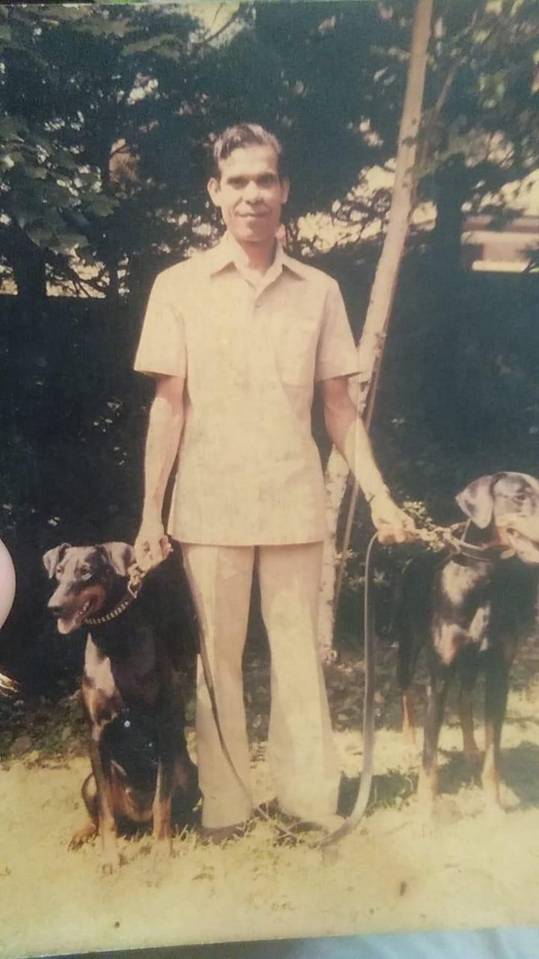
This is the only photograph, and a bad one, I have of my dogs with Ram Prasad. From left to right: Nisha, Ram, and (part of) Surya.
My dog Surya is at the origin of my interest in ITC and of my EVP experiments. The pain caused by his death was the most tragic event of my life. And a few years later, together with a friend who had lost her only much-loved young son, we began our quest to find out what, if anything, existed beyond death. I talked about it at length in my first book Electronic Voices, Contact with Another Dimension? (2010).
When my dog passed away, I literally felt I couldn’t go on living. I thought that I was going to die and I wanted to die. But there were Nisha and the puppies and I persevered in life at great cost and agony. Little by little I got better but never healed completely.
Later, my Nisha and the ‘puppies’ as I always called them, also left me one by one. My mother, knowing how much I loved them, used to tell me “Belinha, you will suffer terribly when you see them go, one by one. So much pain…” She was right.
Surya and Nisha increased my love for animals to levels I had never deemed possible. For as long as I can remember, I have felt special tenderness and concern for animals but after experiencing such intimate and daily contact with my dogs, the love I feel for them is boundless and I think that I understand their true nature which is higher than we, humans, are capable of perceiving.
This love was also at the origin of Abrigo, the shelter for abandoned dogs and cats that I founded on my property near Lisbon: Abrigo Associação | Abrigo Associação.
At the big gate of the property there are two majolica tiles that I was able to order and made me very happy – one has the image of a sun in memory of my dog Surya; the other one has the image of the moon in memory of my Nisha. Her name in Sanskrit means deep night and represents also a Vedic goddess in Hinduism. She is the personification of the night but I used the moon because it was easier to depict than the deep dark night… They are surrounded by 18 little stars representing the two litters that Nisha conceived.
My Nisha was highly intelligent and animated, a Doberman of smaller size than what corresponds to her breed. I have told stories that illustrate Nisha’s ingenuity in some of my books; thus, I will not repeat them here. But I can’t miss the opportunity to tell my readers about the trick she invented to eat Surya’s food, something I consider extraordinary.
Surya never had much of an appetite, perhaps because of his latent illness. On the other hand, Nisha was always hungry. We were living in Tokyo when these episodes occurred. With great effort, I had found a pleasant house with a small garden, which was essential because they needed space, even if it was limited. It was a nice-looking, half-Japanese house with charming tatami rooms in Suginami-Ku, near the beautiful Ohmiya Shinto shrine and park where I used to take Surya and Nisha for walks.
Going back to Nisha’s story, I must say that this was one of many similar occurrences. The small garden in front of the house finished in an alley for the car and a gate to the street, one of Tokyo’s many nameless tortuous streets.
Aside from walks in Shinto Park, Surya and Nisha had no other distractions besides watching the cats passing by the gate and, occasionally, a couple of people walking by. They enjoyed the cats very much and got excited about them. They were still very young dogs and thus, very active.
As I said, probably because of his disease, Surya had very little appetite and it was very difficult to get him to eat. I had to feed him by hand frequently. On the other hand, Nisha was a little overweight and had a voracious appetite. Surya took ages to eat his food and Nisha finished hers in a minute. She used to wait around him until he took a break from eating and then, suddenly, she would devour what was left in his bowl.
But one day I noticed that she had invented an easier and faster way to get to his food. While they were both eating and she, as always, had finished but he had not, she would run to the gate and make what I assume was her special bark for when a cat crossed the street. This caused Surya to leave his plate and immediately run to the door to bark at the supposed cat, which obviously did not exist. Although I am not a psychologist, I believe Nisha’s actions involve complex reasoning, including deception, and an elaborate understanding of cause and effect.
In the next audio, I compiled a couple of segments of a childlike voice that identified itself as my Nisha’s and spoke via the DRV.
She obviously knew how distressed I was after their departure and wanted to comfort me when she said “É a Nisha, nós estamos aqui!” (It’s Nisha, we are here!). Next day I asked my Rio do Tempo friends if it had really been her who had spoken. The male voice replied, “Sim, por acaso” (Yes, it happens that it was) and seconds later the same voice confirmed: “Foi p’ra ti!” (It was for you!). In the following days I again heard a little voice saying “Nisha” and I asked if it was her. At the end of the recording, I addressed her and asked “mummy?” because that’s how I used to call her affectionately.
The little voice is faint but it is possible to hear her reply and confirm: “Sim!” (Yes!). Although they are all a precious gift, I can truthfully say that Nisha’s talk has been one of the greatest joys of my entire ITC life and I believe it is not necessary to explain why… The wonder persists and my eyes still fill with tears every time I listen to the recording.
AUDIO 9. Nisha_nós estamos aqui_Rio do Tempo_foi pa ti
The times, volume and all radio noises were maintained in the original audio. The little voice began the conversation by saying, “Nisha, nós estamos aqui” (Nisha, we’re here). The NR version follows. Readers unfamiliar with the language should listen to the NR audios, which are clearer. Rio do Tempo confirmed that it was she who had spoken and ended with: “Foi p’ra ti!” (It was for you). The CD I published to illustrate my first book includes some of these audios:
Book’s CD “Electronic Voices”Voices speaking about Nisha appeared on other occasions. Although for the reason already mentioned, I cannot find that specific audio file, my communicators once told me that “Nisha had learned how to speak through the radio”. Therefore, intelligent Nisha learned how to speak with our world!
In the next audio there are two different EVP voices that appeared during a DRV transmission – after the sigh at the beginning, a soft female voice that seems to say “Vá Nisha!” (come on Nisha!) followed by a completely different voice as if of an old lady, complaining in German that she had been mediocre (supposedly when she lived in our world because she speaks in the past tense). At the end perhaps “Nisha” again. The initial sigh must also be by the old lady.
AUDIO 10. Vá Nisha! Ich war medioker (German) Nisha (?)
My Nisha must have learned very well how to speak through the radio because she intervened in my recordings on several occasions.
AUDIO 11. É a Nisha! ORIG
In this beautiful recordingI heard asoft little voice and asked “Quem fala?” (Who is speaking?) and the little voice immediately replied, “It’s Nisha!” loud and clear. Also, if we listen attentively, there is a very faint little voice that whispers “Nisha” before the louder one. This is a common occurrence in ITC voices. I witnessed the same phenomenon at Bacci’s centre in Grosseto when I went there to participate in his experiments.
As I said, my dogs had two litters of puppies and four of the eighteen Nisha had, stayed with me and came from Tokyo to my estate in the South of Portugal together with their parents and Ram Prasad. At the time, they were six-month old puppies. To my great joy, I have ITC recordings that speak about all of them and anomalous voices saying their names.
For a lack of words, I cannot describe properly the wonderful feeling of fulfilment that ITC voices bring us. It’s magic happening before our eyes. It’s unreality becoming reality for our incredulous ears. Nothing compares to it. For me, no earthly joy, no matter how great, is comparable.
These are the four puppies that stayed with me:
Black Beauty of Nisha:
I called her Blackie and I adored her but she left me when she was barely five years old. She suffered terribly with visceral Leishmaniasis and had a very difficult death. With the exception of Nisha who left our world in a brief moment while eating a biscuit, they all had very difficult deaths that haunt me. But perhaps I should remember the angelical voice that answered my complaint about the suffering of innocent, pure beings with, “it’s the Law of Karma” (see: https://www.youtube.com/watch?v=zDAGVYnGEy8&t=275s)
AUDIO 12. É a lei do Karma!
You can hear me crying at the beginning of the audio because of the suffering I had seen a poor stray cat go through; the EVP voice appeared (which of course I didn’t hear directly) and I continued apologizing to the communicators for my crying. Perhaps some of my readers have already heard this audio, which I have posted a few times because I consider it extraordinary and very enlightening.
Moreover, Maggy Harsch-Fishbach’s and my communicators informed that when animals go through great suffering, they are freed from reincarnation in our world. And this idea is a great relief for me!
I was working when my Blackie passed away and when I came back home, she was already gone. She was lying on a bed in one of the bedrooms of the big house and, as directed by the veterinarian, she had tubes all over her frail body in an attempt to save her life, I suppose. My housekeeper told me what had happened the moment I entered the living room and even before I saw her, I immediately felt an exhilarating sense of liberation, relief, and joy similar to what I had felt on the way to my father’s funeral, as I described in one of my books.
My precious Blackie was my favourite companion for a short time after her father’s death. I had very special affection for her. She had been adopted in Tokyo but fortunately, she had been returned to me because she did not adapt to her new family. To apologize for the inconvenience, the kind people who could not have a Doberman in their Japanese home, brought me a beautiful lacquered tray as a gift, which I have kept with great care and love for her in my home to this day.
I present this recording in a different way:
AUDIO 13.1 Blackie_correcto
This is a piece of the much longer original recording, unedited, so that my readers realize how difficult it is to understand some DRV voices, particularly when there is too much noise.
AUDIO 13.2 Rio do Tempo answers about Blackie_Correcto_Black dog (the most understandable words only edited with NR)
AUDIO 13.3 I repeat and explain the meaning in Portuguese:
Blackie’s name is unclear at the beginning of the recording (omitted), but I think we can assume that’s what they said, mainly because they respond “Correct” twice when I ask them to confirm if they had talked about her.
At the end of the audio clip, the male voice clearly utters “black dog” and Blackie was a black Doberman. It’s worth noting that Rio do Tempo uses an expression in English “Black dog!” in this recording. They used English on very few occasions, one of them being when they spoke with Professor David Fontana in my studio (Fontana, 2005, pp.371-377). On this memorable occasion, the voices also repeated a phrase that David dictated and asked them to repeat.
Unfortunately, my beloved Blackie died a few months after my dog Surya and a few weeks after my dearest father. That was for me the annus horribilis of 1993.
I was again in despair and sorrow but to a lesser degree; indeed, although I suffer terribly when one of my much-loved companions leaves me, I really “died” when my dog passed away. I have never felt so much pain and grief.
On another occasion when I asked about Blackie, my communicators told me: “Blackie is with grandma” (translation), but unfortunately, I could not find that specific audio. I have many hundreds of recordings and if, as I suspect, it is a short phrase in the middle of a much longer conversation, it would be impossible to find it except by chance since I use some of the most important phrases spoken during the contact as the file title, which I then save on my computer.
Bela Michi of Nisha
Little Michi was born with very severe gastroesophageal reflux disease. She was a sick little dog very shy and loving. When she was born the Japanese veterinarian – my Doberman puppies were all born in Tokyo – said she couldn’t live and that I’d better put her to sleep. I did not agree and for some years, she lived relatively well although with swallowing difficulties as expected. She would vomit frequently. Her life was not easy but she had an admirable loving nature and she would adjust. Until the day she left our world when I was sitting beside her after a crisis of vomiting, and could feel a strange, very fine and sharp vibrating current, similar but not identical to electricity, leave her body under my hand at the moment of her death. I tell the story in my book Electronic Voices, Contact with Another Dimension? (2010, p. 29).
AUDIO 14.1 2013 07 07_11 Sou o Só com a Mi_Michi ORIG
Since I couldn’t immediately find better recordings about little Michi, I’m posting this quite noisy audio. The main voice kept talking and I couldn’t understand much, so I extracted some phrases more intelligible and relevant from the original audio to another file and omitted the rest of the recording, which lasts over 20 minutes.
At the beginning we can hear a gentle voice calling “Michi” and a possible reply “É sim” (Yes, it is), “Muito, aqui”, then “Tempo” [Rio do Tempo] at 00:15’’,6. I heard Michi directly but because I was expecting Nisha to talk and not Michi and the names are similar, I called: Nisha? at 00:22’’; then, we hear “Sou o Só com a Mi” (I am Só with Mi) at 00:25’’. At the very end, a sweet voice gently calls Michi, preceded by Belinha (my pet name) at 00:40’’. Tentatively, the last word sounds like “tem voz” (has voice).
From this piece I extracted the clearest words to another file to make it easier for my readers to understand:
AUDIO 14.2 Michi_É sim_Tempo_Sou o Só com a Mi_Belinha tem voz
I think the word “Mi” that can be heard clearly is about my other dog, Nina, an abandoned puppy the size of my hand when someone left her in front of my garden gate. I will talk more about her in following writings. Actually, I used to call Nina, who arrived many years later, Mini or Mi, while I never called Michi, Mi… And of course, as I explained, Só is one of my important communicators after Carlos de Almeida stopped talking.
I believe this long recording (not published), of which I extracted the sample you just heard, is an example of what communicators call “their work”; they sound as if they are practicing with words, but at the same time they are attentive to our thoughts and what we say, because they often mix their responses into their repetitive speech. I have many recordings from Rio do Tempo station similar to this one.
Byron Lord Seta of Nisha
He was a big Doberman with a sweet character and very playful. A Doberman that would welcome a thief with a big hug and loved to be thrown a ball for him to catch!
Audio 15. Vi o Seta a correr_nem a bola pediu_existem fora do tempo
“Vi o Seta a correr” (I saw Seta running); the last word is not very clear but Seta is quite clear and the rest of the speech applies to Seta. Another voice asks: O que é que tu sabes? (what do you know?). His companion replies: Ele está bom, nem a bola pediu, é o Celso e o Franco (He’s fine, he didn’t even ask for the ball, it’s Celso and Franco).Celso and Franco continued their discussion, which I can’t fully understand, so I didn’t include it in this audio.
This unexpected conversation between two unknown male communicators is great because they seem to know a lot about Seta and myself. As I said, my “puppy” Seta had the habit of constantly asking anyone around him to throw something, usually a ball, for him to catch.
At the end of their very long talk, one of the male voices uttered (published here as well): “Existem fora do tempo!” (they exist outside of time!). The assertion that their world is outside of time is recurrent in the most advanced ITC contacts. And Rio do Tempo told me the same thing. See: ITC – A Transpersonal Connection:
http://www.itcjournal.org/?p=6728
“Somos doutra dimensão, somos p’ra lá do tempo…” We are from another dimension; we are from beyond time; (Playback included in the audio).
Next is a noisy DRV recording of 1998. The female voice had already identified herself clearly as Joan Colbert (not included). She became one of my dearest communicators because she was gentle and always present, often speaking about my dogs. She again mentions Seta in the next audio.
AUDIO 16. O Seta como corre daqui às esplanadas ORIG+NR
“O Seta muito” (?) or, “como” (?) “corre daqui às esplanadas” (How Seta runs from here to the esplanades); next it becomes less understandable, although it seems to say “É sempre um círculo de luz…..?” (It’s always a circle of light….?)
I’m posting this audio so my readers can get a better idea of how some DRV happen and sound, and the difficulties involved. The main point is that we must be aware that pareidolia constitutes an imminent danger. Naturally, when the female voice pronounces “Seta” in this noisy, poor-quality recording, there is no doubt but the rest is highly doubtful, and not only can we not guarantee its meaning, but we shouldn’t even try to guess its content. This should be an indispensable precaution for serious ITC operators.
Statements like “Seta runs a lot” are very comforting because they convey to us the feeling of vitality and well-being that our loved ones seem to enjoy in the next dimension of life.
Barbara Lady of Nisha:
She was a very beautiful, delicate and a sensitive Doberman that I used to simply call Lady. When I was assigned to Galicia, Spain as Consul-General of Portugal, only she and her brother Seta came with me because the other ones had already left our world. Later, her brother also died and she became the only one of our initial family who stayed with me. We became extremely attached to each other and I used to call her “Bébé” (Baby). We were united by overwhelming love and tenderness.
AUDIO 17. Oh Bébé! ORIG (a little of the DRV and EVP Oh bébé)
In this EVP recording obtained during a DRV communication with Rio do Tempo, a delicate female voice imitates my usual way of calling Lady, “Oh Baby!”. A noisy, unintelligible fragment of the DRV preceding the EVP can be heard in the audio. And at the end of the clip, next to the EVP, although I am not absolutely sure, I would say that the second bark that is heard is also anomalous, although the first one seems to be Lady’s from what I remember, and she used to be with me in my studio. Right at the beginning, when I started receiving the DRV (this is a 1998 recording), there was a lot of noise mixed with the anomalous voices. But when Carlos de Almeida started speaking, they became much clearer, often completely intelligible.
Lady always knew the time I would start my journey from Vigo, some 14 kilometres away, to return home after work. She signaled my arrival to the maid through her body language and excitement. The maid invariably had hot food on the table when I entered the house and one day she told me the story. I always arrived at different times, but she still knew…
Like all her siblings, she was born in Tokyo and started by being adopted by a Japanese man who seemed to be loving and caring. He lived outside of Tokyo in a country estate where I visited them a couple of months later. My Lady looked frail and shy as always and very nervous, although relatively well. But she was limping heavily!
I asked, and then the man told me the story. He could not have her in the house because his wife would not agree. Knowing the Japanese and their obsession with cleanliness and their mania of not wearing shoes at home, etc., I had no doubt that he was telling the truth. However, Lady had become very attached to him. She didn’t like anyone else in the house. So, when he had to leave, he would leave her in the first floor of another cabin in front of the main house. And one day, she jumped from the balcony to be with him and broke the head of her femur as we found out later. In the meantime, it had kind of healed but she limped strongly. She was a four-month-old puppy. I brought her home; she had surgery and finally she became much better.
My Lady was my joy and the last one of the canine family that changed my life.
As her siblings and parents, she also suffered from the fatal leishmaniasis that, one way or another, killed them all. In her case the heart was heavily damaged. My veterinarian in Vigo, one of the best in the country, did everything she could to keep her alive. Until one day, when I traveled to the distant Alentejo to bring my mother to Galicia to spend some time with me, and upon my return, I found out that she had passed away.
My housekeeper Mukesh was waiting for me at the door, trembling, and told me the story. I cried in despair but had also to attend to my mother who had become somewhat affected mentally. And although I cried silently, I tried my best to get over it for the sake of my mother and the abandoned dogs I had rescued who lived with us. But she has always been my baby. It has been more than 26 years since she left this world but her absence and the memory of our love still make me cry.
My love story with dogs
However, long before I brought my Surya and my Nisha home in New Delhi, I already had a love story with dogs. But I was too small to think about it and to understand what it meant in my life. I just felt delight in their company. I also loved chickens, rabbits, turkeys, donkeys and others, although to a lesser extent.
I grew up on my maternal grandparents’ beautiful farm in Alentejo, a southern region of Portugal, as I tell in my book Glimpses of Another World, Impressions and Reflections of an EVP Operator (2021). Since early childhood, I lived through many stories related to animals and I remember well the fury and revolt, the horrible helplessness that I felt when I saw them suffer for any reason. Feelings that I still experience deeply and make my life miserable because our world is tragic for animals.
Actually, I’m sure that if I hadn’t suffered so much with the death of my beloved dogs, I would never have come across ITC and the possibility of communicating with the next dimension where our dear communicators tell us the dead live. Not because of the consolation invented by my subconscious, as some suggest, but perhaps because the pain is such that it created in me an overwhelming “visceral interest”, a condition that greatly favours the establishment of contacts, as our dear communicators have informed us.
Gallito and Bailador
Gallito was my grandparents’ big dog. He used to carry me gently on his back when I was four or five years old, and never get upset. He was a great companion whom I have not forgotten. After Gallito died in a car accident, Bailador was their next, big dog of the same breed. Bailador had a fierce, very different character from Gallito and that caused him many problems and me some concerns and sorrow.
But I became a teenager quickly, I went to the University in Lisbon and forgot about my happy life as a child when I got fully exposed to the appeal of boyfriends, sexual life and all other admirable novelties including total freedom. In the meantime, not wanting to obey my parents’ rule, I left their house to live on my own when I was only 18 years old.
In the last stage of their lives, my grandparents suffered bankruptcy and lost everything.
They had been very rich people, the richest in the entire southern region of the country. They had to move to Lisbon to live in a small apartment. Bailador was left behind and must have suffered terribly, alone, with no food or shelter until he died, as my mother used to tell me years later when I asked about him.
And then one day, during a DRV conversation, I suddenly asked Rio do Tempo how Gallito and Bailador were doing because I thought about them from time to time. To my great surprise, the wonderful female voice that usually spoke to me, and I suspect it was Joan Colbert, one of my favourite personalities from Rio do Tempo station, answered about them! How extremely happy I was with that incredible response about one of my childhood dogs so many years later! I never tire of saying that ITC voices are unmatched in terms of magic and reach, and this is a good example as I’m sure my readers will agree.
The female voice told me about Bailador, not Gallito, while I was much closer to Gallito than Bailador, whom I barely approached because my parents advised me not to and I was just a child.
Reviewing this fascinating, totally unexpected happening, I’m inclined to think that when the voice answered and mentioned Bailador but not Gallito, the well-loved dog of the family, she probably did it for a reason. Gallito had lived his full life in reasonable conditions, although at the time in a big farm, dogs were not loved nor cared for as my own dogs have been, but Bailador had been totally neglected.
Thus, perhaps when the voice responded, “Bailador will be very grateful for that turn” that’s what she meant – he was happy because I remembered him and had asked about him. After all, I was a member of the family that had abandoned him and he knew that very well… My thoughts are wandering of course, but I believe I may be right.
And right now, at the end of the year 2025, I just found out on the Internet who Bailador was, I mean where the name came from. I checked to find out the correct spelling of Gallito. I knew Gallito had been a Spanish bullfighter because my grandparents had told me, but I never enquired about Bailador. And this evening, while I write these lines, I found on the Internet that Bailador was the bull, the “toro”, that had killed the famous Gallito!
At that time, I was a little girl who didn’t know about these stories but, to my dismay, I found out later that my maternal family was fond of bullfights, something very much in vogue in the 1950’s, particularly in the south of Portugal and certainly in nearby Spain.
Continuing my story, I wonder what symbolism, if any, is implicit in this narrative. Bailador, the “bad”, fierce dog (in my grandparents’ and my parents’ view) and Gallito, the good dog. How strange, I think, but perhaps this is just my imagination and it’s all a coincidence that doesn’t involve symbolic reasons. Who knows?
Once, a voice I think was the Technician’s, the higher entity that communicated mostly in Luxembourg (see Locher and Harsch, 1989; Senkowski 1995; Cardoso, 2010, 2017, 2021) said during my own experiments: “En el mundo (Spanish), tudo tem significado, tudo! (Portuguese)” (translation: In the world everything has meaning, everything!)”. And at the Harsch-Fischbach’s, the high entity affirmed: “Don’t look for the reason for suffering, illness, or disability. Everything has a deeper meaning” (Schäfer, p. 163).
Like all the other recording excerpts I present in this article, what follows is a fragment of a very long and extraordinary conversation that began with my maternal grandmother and continued with another female voice that appears to have authority. It is interesting to note that this last voice has a Spanish accent. Generally, the DRV that speak with me do so in Portuguese with very few exceptions.
AUDIO 18.1 Conversa avó e Bela(Excerpts CONVERSATION GRANDMA with ANABELA with slight NR)
“O Bailador ficará todo agradecido por esse turno” (Bailador will be very grateful for that turn).
AUDIO 18.2 Anabela_EXPLAINS and TRANSLATES CONVERSATION with GRANDMA
References:
Brune, F. (2009). Les Morts Nous Aiment. France, Agnières : JMG Éditions.
Brune, F. (2012). Mes Entretiens avec les Morts. France, Agnières : JMG Éditions
Cardoso A. (2010). Electronic Voices: Contact with Another Dimension? Ropley, Hants, UK: O Books – John Hunt Publishing, Ltd.
Cardoso A. (2010). CD: Electronic Voices (www.itcjournal.org)
Cardoso A. (2017). Electronic Contact with The Dead: What Do the Voices Tell Us? UK: White Crow Books.
Cardoso, A. (2021). Glimpses of Another World, Impressions and Reflections of an EVP Operator. UK: White Crow Books.
Cardoso, A. (2023) Friedel’s Conversations with the Dead. UK: White Crow Books.
Cummins, G. (1932; 2012). The Road to Immortality. UK: Ivor Nicholson & Watson Limited; UK: White Crow Books.
Fontana, D. (2005). Is There an Afterlife? UK: Ropley, Hants, UK: O Books – John Hunt Publishing, Ltd.
Jürgenson, F. (1964). Rösterna från Rymden (The Voices from Space). Stockholm: Saxon & Lindstroms.
Jürgenson, F. (1967). Sprechfunk mit Verstorbenen (Freiburg im Br.:
Verlag Hermann Bauer. Republished 1981 by Goldmann Verlag (München).
Jürgenson, F. (1968). Radio och Mikrofonkontakt med de döda. (Radio and microphone contacts with the dead) Uppsala: Nybloms.
Jürgenson, F. (2004). Voice Transmissions with the Deceased.
Stockholm: Firework Edition No 101. The Jürgenson
Foundation: http://www.fargfabriken.se/fjf/
König, H. (2007). Psychic structures as connections to other realities. In A. Cardoso and D. Fontana (eds.) Proceedings of the Second International Conference on Current Research into Survival of Physical Death with Special Reference to Instrumental
Transcommunication (ITC). York, England: Saturday Night Press Publications on behalf of ITC Journal Research Center, Vigo, Spain.
Locher, T. and Harsch, M. (1992) Transcomunicação, A Comunicação com o Além por
Meios Técnicos. (Portuguese translation of the German original). São Paulo: Editora Pensamento.
Locher, T. and Harsch, M. (1989). Les Contacts vers l’Au-delà à l’aide de moyens techniques existent ! Association Suisse de Parapsychologie et Cercle d’Etudes sur la Transcommunication du Luxembourg. (1995, French ed., Agnières: Parasciences).
Schäfer, H. (1989). Brücke zwischen Diesseits und Jenseits. Freiburg: Verlag Hermann Bauer KG.
Schäfer, H. (1993). Ponte entre o Aqui e o Além – Teoria e Prática da
Transcomunicação. Sao Paulo, Editora Pensamento (Portuguese translation of the above-mentioned work).
Schäfer, H. (1992). Théorie et pratique de la Transcommunication. Paris: Robert Laffont.
Senkowski, E. (1995). Instrumentelle Transkommunikation (first ed. 1989) Frankfurt: R. G. Fischer.
Senkowski, E. (1999). Die Transkontakte des Adolf Homes – Ein rückblick. Teil 1: übersicht und transpartner (The transcontacts of Adolf Homes – A review. Part 1:
Synopsis and Transpartners). TransKommunikation. Vol. IV.
Senkowski, E. (1999). Transcomunicazione. Available from Dr Carla Castagnini, Strada Statale Romana Nord, nº 135, I -41010 Fossoli di Carpi (MO), Italia.
i As with virtually all the recordings presented in this article, I selected fragments from much longer DRV conversations and pasted them into other files, since I’m only interested in the content relevant to my narrative. Typically, the original pieces are followed by the same ones, processed with noise reduction. ii The numbers visible in the title of some audio files posted here are dates or reference numbers that identify that particular file in my archives. iii When the recordings are very clear I don’t do noise reduction.
iv Acoustically, the Spanish word ‘perro’ is very audible and strong because of the double consonant while ‘cão’ in Portuguese is a muffled sound barely audible. I think this is the reason why they use the word ‘perro’; however, on rare occasions they have used ‘cão’. v The background noise, reminiscent of a choir, also came from the communicators. vi Está no espaço (to be in space) is a very frequent expression in my DRV recordings. It probably means that the communicator has entered our space. F. Jürgenson’s voices already spoke about “the space” and that is perhaps the reason why Jürgenson called his first book “The Voices from Space” (1964). vii This is a long audio from which I extracted the phrases that apply to my text. viii Unfortunately, I can’t cite the sources because I honestly don’t remember but I’ve read about it many times.